Memory loss and depression after a crash are common signs of a brain injury or of the body’s response to trauma, and both should be evaluated by a doctor as soon as they appear.
Memory Loss and Depression Are Real Car Accident Injuries
Mental injuries after a car crash can be just as significant as physical ones. Memory loss and depression are just two examples of psychological injuries that can impact a victim’s life as severely as physical pain, affecting their ability to function, work, and enjoy life.
Both are common symptoms of a traumatic brain injury, so it is crucial to seek proper medical and legal assistance if you or a loved one experience depression and memory loss following a car wreck. Our Ohio brain injury lawyers handle these cases across the state.
Car accident victims often forget what happened before, during, or after a crash. And while memories can come back eventually, memory loss could also be a sign of a more severe brain injury. Memory loss often follows a concussion, the most common of the brain injuries from car accidents, and the sooner you identify and deal with it, the better. If you are not sure whether you had one, learn how to recognize a concussion.
Types of Memory Loss
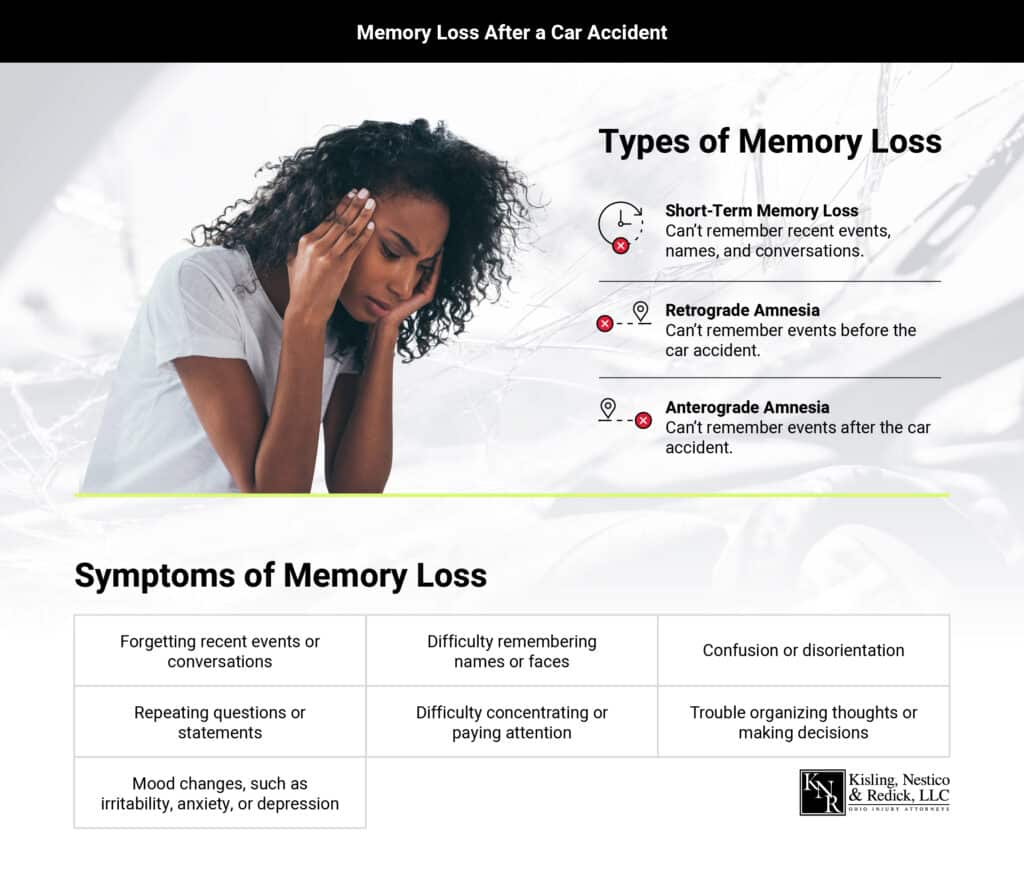
Memory loss after a car accident can manifest differently, and the severity can vary from person to person. Here are the common types of memory loss that may occur after a car accident:
Short-term memory loss is the most common memory loss after a car accident. It affects the ability to remember recent events, names, and conversations.
Retrograde amnesia refers to memory loss that affects the ability to remember events before the car accident. The severity of this type of amnesia varies from person to person.
Anterograde amnesia affects the ability to form new memories after the accident. It can be temporary or permanent.
Post-Traumatic Amnesia (PTA)
PTA is when a person experiences memory loss for events immediately before or after the injury. During PTA, a person may be disoriented, confused, and have difficulty forming new memories. The severity of PTA can vary, and the duration of PTA can range from a few minutes to several months, depending on the severity of the TBI.
Signs of Memory Loss
It can be hard to admit you’re having trouble remembering things after a car wreck. But limited cognitive function can significantly impact a person’s daily life and ability to perform tasks. Here are the common symptoms of memory loss after a collision, and they should not be ignored:
Forgetting recent events or conversations
Difficulty remembering names or faces
Confusion or disorientation
Repeating questions or statements
Difficulty concentrating or paying attention
Trouble organizing thoughts or making decisions
Mood changes, such as irritability, anxiety, or depression
Treating Memory Loss after a Car Crash
Prompt medical attention after a car accident can help diagnose and treat any underlying injuries or conditions that may be causing memory loss. Seeking help early on can also improve the chances of a successful recovery and prevent further complications.
While everyone’s situation is different, treatment for memory loss after a car accident can include cognitive rehabilitation, which involves exercises and strategies to improve memory and cognitive function. This includes memory games, organization techniques, and exercises to improve attention and concentration.
Other treatments can include medication and therapy to address underlying mental health conditions such as depression or anxiety.
¿Tienes un caso? Solicita hoy mismo tu evaluación 100 % gratuita
Somos abogados galardonados y altamente cualificados
How Long Does Memory Loss Last After a Car Accident?
There is no single answer, because the answer depends on what caused the memory loss. After a mild concussion, most people find that memory returns to normal within hours to days, and most of the rest recover within a few weeks. The memories of the crash itself may never come back, which is normal; the brain often does not store the moments around a sudden impact.
A moderate or severe brain injury is different. Post-traumatic amnesia can last days or weeks, and the longer it lasts, the more likely it is that some memory and thinking problems will persist for months or become permanent. Age, prior concussions, and other injuries all affect recovery.
Because every case differs, the rule is simple: if memory problems last more than a couple of weeks, get worse, or come with headaches, confusion, or sleeping a lot after a car accident, see a doctor. The medical records created along the way are what prove the injury later.
Short-Term vs. Long-Term Memory Loss
After a crash, memory problems show up in two ways. Short-term memory loss affects what happened minutes or hours ago: a conversation you cannot recall, a question you ask three times, an appointment you forgot to write down, a pot left on the stove. It is the more common form after a concussion. Long-term memory loss affects information that was stored before the crash, such as names, places, skills, or events from years earlier. It is less common, and when it appears it usually points to a more serious injury.
Both can be temporary or lasting. The distinction matters to your claim because short-term memory problems affect work, school, and safety in ways that are easy to underestimate, and because the insurer will argue that anything you cannot document was never there.
Tests Doctors Use to Diagnose Memory Problems
Diagnosing memory loss after a crash starts with a history and a neurological exam, and often continues with:
CT scan. The emergency room’s first tool, used to find bleeding, swelling, or a skull fracture that needs immediate treatment. A normal CT does not rule out a concussion.
MRI. More sensitive than a CT for bruising and small areas of damage, and often ordered when symptoms persist.
Cognitive screening. Short tests given in the office that check orientation, recall, attention, and language and flag problems that need a closer look.
Neuropsychological testing. A detailed battery of tests, usually several hours long, administered by a neuropsychologist. It measures memory, attention, processing speed, and reasoning against normal ranges and turns “I forget things” into numbers that are hard for an insurer to dismiss.
Car crashes are traumatic events that can trigger feelings of sadness, stress, and general unease. How often depression follows a collision depends on the severity of the crash and the injuries, but research has consistently found that people who suffer a traumatic brain injury develop depression at a much higher rate than the general population in the year after the injury.
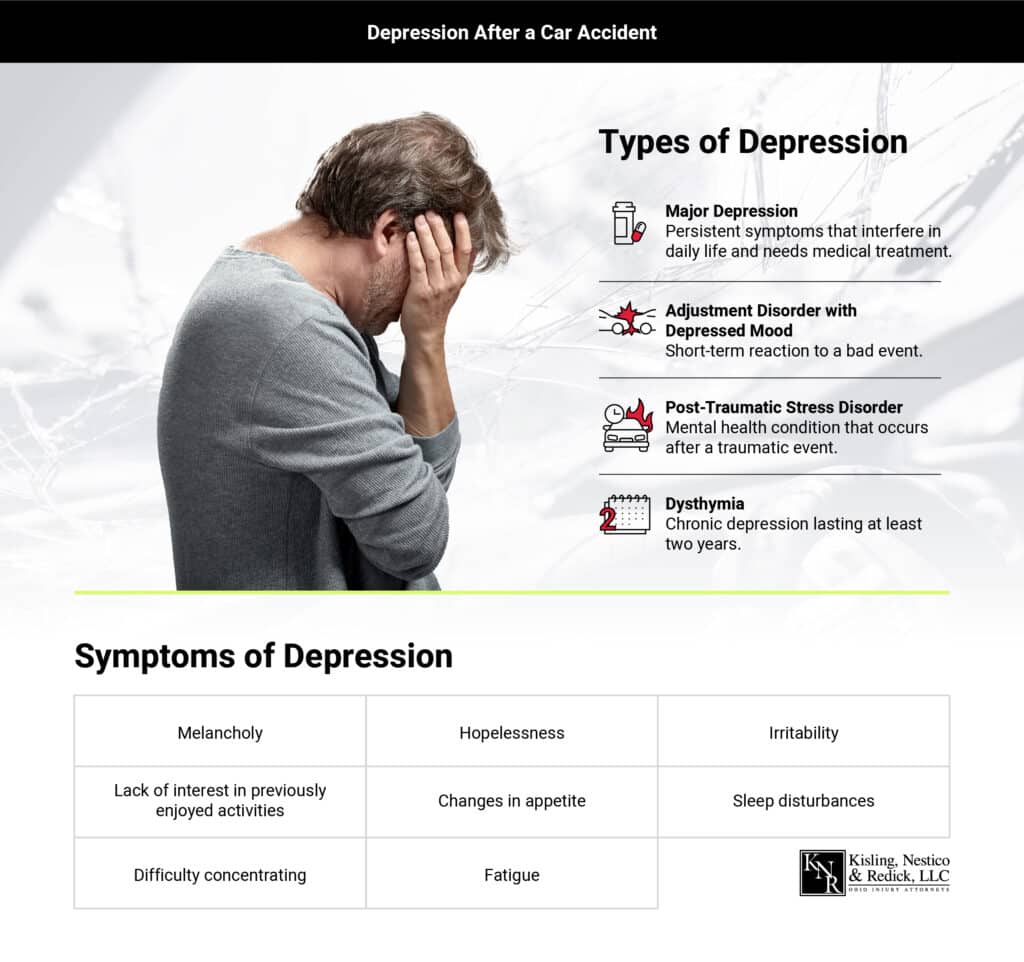
The symptoms of depression can include melancholy, hopelessness, irritability, and a lack of interest or pleasure in once-enjoyable activities. Other symptoms can include changes in appetite, sleep disturbances, difficulty concentrating, and fatigue.
These symptoms can negatively impact the victim’s life, affecting their ability to work, socialize, and carry out daily activities.
Types of Depression
Here are some signs and different types of depression that may occur after a car accident:
Major Depression: This involves persistent sadness, loss of interest in activities, feelings of worthlessness, changes in appetite and sleep, and difficulty concentrating. It may interfere with daily functioning and require medical treatment.
Adjustment Disorder with Depressed Mood: This is a short-term reaction to a stressful event such as a car accident. Symptoms may include feelings of sadness, hopelessness, and anxiety.
Post-Traumatic Stress Disorder: PTSD is a mental health condition that can occur after a traumatic event. Symptoms may include re-experiencing the traumatic event, avoiding reminders of the event, hyperarousal, and negative mood.
Dysthymia: Dysthymia is a chronic depression lasting at least two years. Symptoms may include feelings of sadness, hopelessness, and low self-esteem.
Treating Depression after a Car Crash
Treatment for depression after a car accident can include medication, therapy, or a combination of both. Antidepressants and other medications can be effective in reducing the symptoms of depression.
At the same time, therapy can help the victim develop coping strategies and address any underlying issues contributing to depression.
Cognitive-Behavioral Therapy
Cognitive-behavioral therapy (CBT) is a common approach that focuses on identifying and changing negative thought patterns and behaviors. Other types of therapy, such as interpersonal or psychodynamic therapy, may also be used depending on the individual’s needs.
Lifestyle changes can also help alleviate symptoms of depression. This can include regular exercise, eating a healthy diet, and getting enough sleep. Activities such as yoga, meditation, or mindfulness practices may also help manage depression symptoms.
The Danger of Untreated Depression
Untreated depression can decrease quality of life and increase the risk of developing other mental health conditions or substance use problems. Therefore, it is vital to work with a healthcare provider to determine the most appropriate treatment plan for depression after a car accident.
Treatment may need to be adjusted over time, and it is essential to have ongoing support and monitoring. Seeking proper medical care and treatment can help the victim recover and improve their well-being.
Depression vs. PTSD After a Car Accident
Depression and post-traumatic stress disorder often follow the same crash and share symptoms: trouble sleeping, difficulty concentrating, irritability, withdrawal from people and activities, and loss of interest in things that used to matter. The difference is in what drives them. Depression is a persistent low mood and loss of pleasure that colors everything. PTSD is tied to the event itself, with intrusive memories or nightmares of the crash, avoidance of driving or of the road where it happened, being easily startled, and a sense of being constantly on guard.
Many people have both, and both can be part of a claim. Ohio law allows recovery for the mental and emotional harm a negligent driver causes, including the cost of treatment and the effect on your ability to work and enjoy life. Our page on PTSD after an accident covers that diagnosis in more detail. The important thing is to get evaluated: a diagnosis made and documented by a treating psychologist or psychiatrist is far harder for an insurer to dispute than symptoms you describe on your own.
Documenting Memory Loss and Depression for Your Claim
Invisible injuries are proven with paper. From the first week, build the record the insurer will demand:
A symptom journal. A daily note of memory lapses, mood, sleep, headaches, and what you could not do that day.
Treating physician notes. Report every symptom at every visit, including the ones that embarrass you. If it is not in the chart, the insurer will say it did not happen.
Therapy and counseling records. A diagnosis, a treatment plan, and a record of attendance show that the depression is real and that you are doing what your providers recommend.
Test results. Imaging reports and neuropsychological testing scores.
Statements from family and coworkers. The people around you notice changes you may not: repeated questions, a shorter temper, missed deadlines, a withdrawal from friends.
Compensation for Memory Loss & Depression After an Accident
A brain injury may limit your ability to work, socialize, and live a normal life. In some cases, depression and memory loss are temporary and can improve over time, while in others, they can be long-lasting and indicative of a more serious traumatic brain injury.
Someone suffering from depression or memory loss after a car crash may be unable to earn a living as they did before or require ongoing medical care and therapy. If another’s negligence caused the accident, you might be entitled to compensation for your losses. This can include reimbursement for medical expenses, lost wages, and pain and suffering.
If you or a loved one are experiencing memory loss or depression after a car accident, it’s wise to consult a personal injury lawyer about the compensation you deserve and how to best protect your legal rights. By pursuing an insurance claim or lawsuit for the losses related to your depression or memory loss, you can recover the costs of your medical treatment, rehab, and other expenses related to your injury and have a sense of closure and justice. Emotional harm is part of the claim when you were physically injured, and in limited situations it can be claimed on its own; our article answers can you sue for emotional distress in Ohio in detail.
Memory Loss and Depression After a Crash: FAQs
Can a car accident cause memory loss?
Yes. The sudden force of a crash can jolt the brain inside the skull and cause a concussion or a more serious traumatic brain injury, and memory problems are among the most common results. Some people cannot recall the crash itself or the minutes before it, and some have trouble holding onto new information for days or weeks afterward. Memory loss can also come from the trauma of the event rather than a physical injury, which is one reason a doctor needs to sort out the cause.
Is depression after a car accident normal?
It is common, and it is not a sign of weakness. Pain, lost work, a totaled car, fear of driving, and the stress of dealing with insurers wear people down, and a brain injury can change mood directly by affecting the parts of the brain that regulate emotion. Depression that lasts more than a couple of weeks, interferes with daily life, or includes thoughts of self-harm should be evaluated by a doctor or mental health professional, and it can be part of your injury claim.
How long does memory loss last after a concussion?
For most people with a mild concussion, memory problems improve within days to a few weeks as the brain recovers. A longer period of post-traumatic amnesia, repeated concussions, or an injury that shows up on imaging can mean months of symptoms, and some people are left with lasting deficits. There is no fixed timeline. If memory problems persist beyond a few weeks, or get worse, see a doctor and ask about neuropsychological testing.
Can I get compensation for depression after a car accident?
Yes, when someone else caused the crash and you were physically injured in it. Depression that results from the accident is part of your injury claim in Ohio, whether it comes from a brain injury or from the trauma and disruption of the crash. Your claim can include the cost of therapy and medication, income you lost because you could not work, and the pain and suffering and loss of enjoyment of life the depression caused. The key is documentation: a diagnosis from a treating provider and records showing treatment over time.
What kind of doctor should I see for memory problems after a crash?
Start with the emergency room or your primary care doctor, who can rule out bleeding or swelling and refer you. A neurologist evaluates and treats brain injuries, and a neuropsychologist administers the testing that measures memory, attention, and processing speed and documents how far they fall below normal. For depression, a psychiatrist or psychologist can diagnose and treat it. Keep going to the appointments; the records are what prove the injury.
Contact KNR about Depression & Memory Loss After a Crash
You may be entitled to compensation for the various losses related to your memory loss or depression. At KNR, our attorneys have helped numerous people recover what they need to move on from the physical and mental harm caused by serious car accidents. Let us evaluate the details, help you get the care you need, and explain what to expect from a claim or lawsuit.
Our offices are conveniently located throughout Ohio. As one of the largest personal injury firms in the state, we have fought for injured Ohioans for over 20 years and know how to get results.
Call 1-800-HURT-NOW for a free consultation, and there are no fees unless you recover compensation.
¿Qué hace que KNR sea especial?
Llevamos más de 20 años prestando servicio en Ohio
Desde nuestra fundación en 2005, Kisling, Nestico & Redick se ha dedicado a ayudar a las víctimas de lesiones personales a luchar por la indemnización que se merecen cuando un accidente afecta a su estilo de vida. Hemos ayudado a más de 10 000 personas y estamos dispuestos a seguir luchando por los habitantes de Ohio y por cualquier persona que merezca una indemnización por sus reclamaciones por lesiones personales.
Consultas gratuitas // Disponibles las 24 horas del día, los 7 días de la semana // Si no ganamos, no cobramos