
Free Consults & Nothing Unless You Win
Our mission is to get max compensation when you need it. KNR removes the risk and uncertainty from your recovery.
Call Today Get Started Online100,000 + People Helped & Over A Billion Recovered
Insurance companies work so you accept less. We work harder to get everything you deserve, and our record proves it.
Case Results12 Ohio Locations Where You Come First
KNR makes getting answers as easy as possible. As a statewide firm, we’re part of your community and ready to help.
Our LocationsLane splitting can help motorcyclists move through traffic in states where the practice is permitted. But if you ride a motorcycle in Ohio, it is important to understand that the rules are different.
Lane splitting is not legal in Ohio. Ohio law allows motorcycles to ride two abreast in the same lane, but that is different from riding between lanes of traffic. Ohio law also generally requires vehicles to remain in a single lane and to move between lanes only when safe to do so.
Understanding the difference between lane splitting and lawful lane sharing can matter if you are involved in a motorcycle accident. Insurance companies may argue that a rider violated traffic laws or contributed to a crash. In some cases, however, a driver may incorrectly describe lawful motorcycle riding as lane splitting.
Knowing Ohio’s motorcycle laws can help riders understand their rights and responsibilities on the road.
Lane splitting occurs when a motorcycle travels between two lanes of traffic, typically between vehicles traveling in the same direction.
For example, imagine traffic is stopped or moving slowly on a two-lane highway. A motorcyclist rides along the space between the two lanes, passing vehicles on both sides without occupying either lane. That is lane splitting.
Lane splitting is sometimes confused with other motorcycle riding practices, including lane sharing and lane filtering. Although the terms are sometimes used interchangeably, they can describe different things depending on the jurisdiction.
Ohio does not have a law that authorizes motorcyclists to travel between lanes of traffic. Instead, Ohio law requires vehicles to remain within a single lane as nearly as practicable.
No. Lane splitting is not permitted on Ohio roads. Ohio Revised Code Section 4511.33 provides that when a roadway has two or more marked lanes, a vehicle generally must be driven entirely within a single lane and cannot move from that lane until the driver has determined that the movement can be made safely.
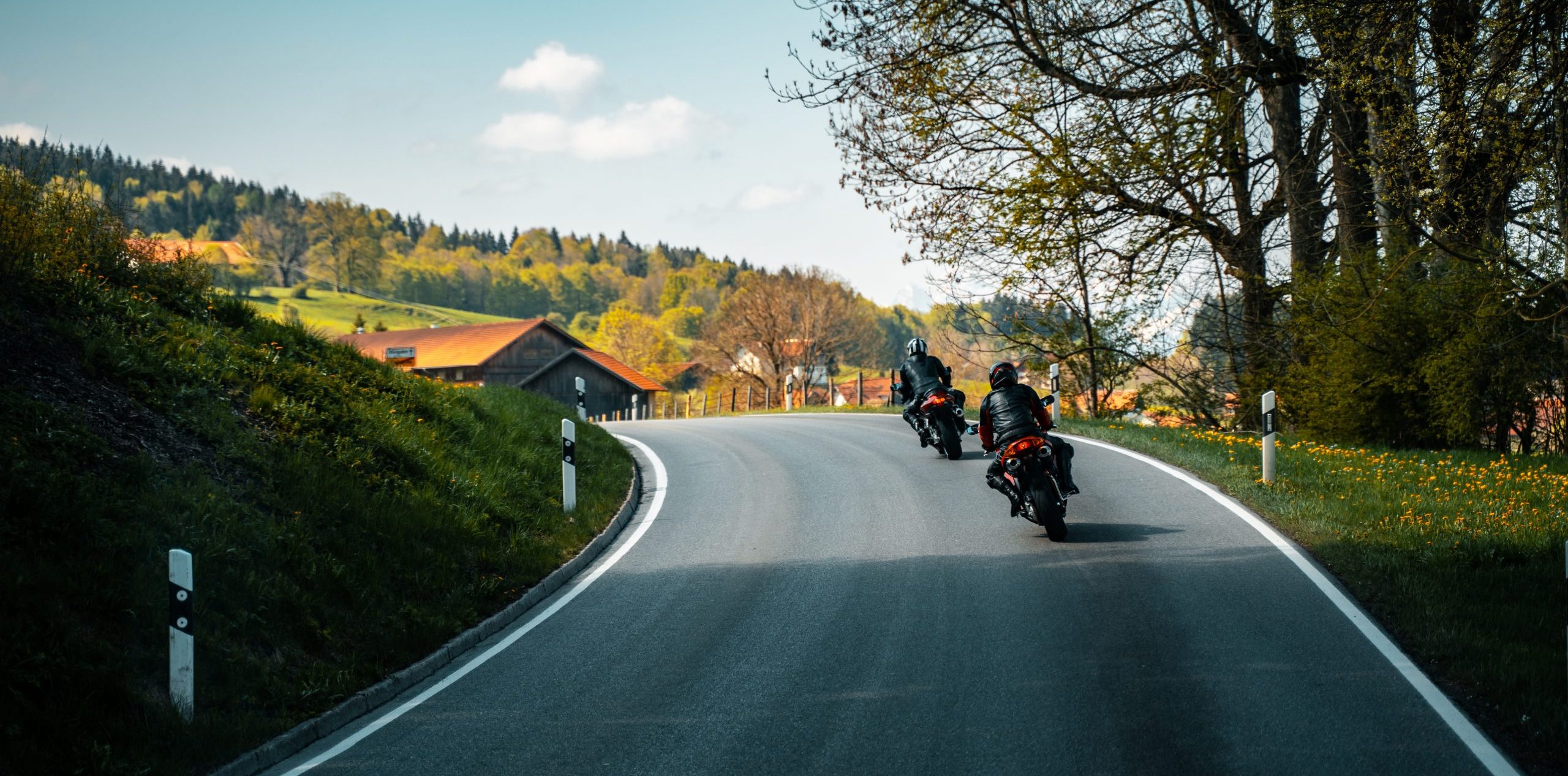
Ohio law also specifically addresses motorcycles traveling side by side. Under Ohio Revised Code Section 4511.55, motorcycles may ride no more than two abreast in a single lane.
This distinction is important:
A rider who is traveling within a lane should not automatically be considered to be lane splitting simply because a motorcycle occupies a different portion of the lane than a car typically would.
Yes. Ohio law expressly permits motorcycles to ride two abreast in a single lane. This is sometimes confused with lane splitting because motorcycles take up less space than passenger vehicles. Two motorcycles can legally ride side by side in the same lane, as long as they comply with Ohio’s applicable traffic laws.
For example, two riders traveling side by side on a two-lane road may both be occupying the same marked lane. That is different from two motorcycles traveling between two lanes of cars.
The distinction can become important after a crash. A driver or an insurance adjuster may incorrectly characterize a motorcycle’s position on the road. Evidence showing where the motorcycle was actually located can help establish what happened.
Lane splitting generally involves a motorcycle traveling between lanes of traffic, often when traffic is moving slowly or stopped.
Lane filtering is sometimes used to describe a motorcycle moving between lanes of stopped traffic at intersections or traffic signals. The terminology varies by state, and some states have adopted laws permitting certain forms of lane filtering or lane splitting under specific conditions.
Ohio does not currently authorize these practices simply because traffic is stopped or congested. For Ohio riders, the important point is that a motorcycle cannot assume that moving between lanes is lawful simply because traffic is stopped or because the practice is legal somewhere else.
One reason for confusion is that lane splitting is legal under certain circumstances in some other states.
Motorcyclists who travel across state lines may encounter different rules depending on where they are riding. A practice that is permitted in one state may violate the law in another.
Another source of confusion is Ohio’s rule allowing two motorcycles to ride abreast in a single lane. Because two motorcycles can legally occupy the same lane, it may not always be obvious where lawful lane sharing ends and prohibited lane splitting begins.
The safest approach is to understand Ohio’s rules before riding rather than relying on practices that may be permitted elsewhere.
Lane splitting can be an important factor in determining how a motorcycle accident occurred and who may be responsible.
If a motorcyclist was traveling between lanes when a crash occurred, an insurance company may argue that the rider violated Ohio traffic laws and contributed to the accident.
That does not necessarily mean the other driver is automatically free from responsibility. The circumstances of the crash still matter.
For example, a driver may have changed lanes without checking for a motorcycle, failed to use a turn signal, followed another vehicle too closely, or otherwise acted negligently. A traffic violation by one person does not automatically erase another person’s responsibility for causing a collision.
Determining fault requires examining the entire accident rather than relying on a single driver’s account of what happened.
It is important to take that allegation seriously, but it does not automatically establish that you were at fault. Motorcycles can legally ride two abreast in a single lane in Ohio. A motorcycle can also occupy different portions of a lane based on traffic, roadway conditions, hazards, and the rider’s need to maintain a safe position.
After an accident, an insurance adjuster may ask where you were riding immediately before the collision. Be precise when describing your position. If the other driver claims that you were between lanes, evidence may help determine whether that description is accurate.
Potential evidence can include:
The physical evidence may tell a different story from the driver’s initial account.
A motorcycle rider who was lane splitting may face an argument that the rider contributed to the crash. But the effect of that conduct depends on the facts of the accident and Ohio’s comparative-fault rules.
Ohio generally reduces a plaintiff’s recovery based on the plaintiff’s percentage of fault. A person can generally recover damages if their percentage of fault is not greater than the combined percentage of fault attributed to the other parties from whom they are seeking recovery.
For example, if a rider and another driver both contributed to a collision, the evidence may be used to determine how much responsibility each person bears.
This makes it important to distinguish between actually lane-splitting and simply being accused of it. A rider who was complying with Ohio law should not assume that an insurance company’s characterization of the accident is correct.
If you are involved in a motorcycle accident, take steps to protect your health and preserve evidence.
Motorcycle crashes can cause serious injuries, including fractures, traumatic brain injuries, spinal cord injuries, road rash, and internal injuries. Some symptoms may not be immediately apparent. Seek medical attention after a serious crash and follow your healthcare provider’s recommendations.
Report the accident to the appropriate law enforcement agency and make sure you obtain information about the crash report.
If you are physically able to do so, photograph the vehicles, motorcycle, roadway, traffic signals, lane markings, debris, skid marks, and the surrounding area.
Get contact information for people who witnessed the crash when possible. Independent witnesses may be able to provide important information about where the vehicles and motorcycle were positioned.
Look for traffic cameras, surveillance footage, dashcam footage, or other recordings that may have captured the collision. Video can be especially valuable in motorcycle crashes because it may help establish the positions and movements of the vehicles immediately before impact.
You may need to notify your insurance company about the accident. However, be careful about giving detailed statements to another driver’s insurance company before you understand your rights. Insurance adjusters may ask questions designed to determine whether you contributed to the crash. You do not have to accept an adjuster’s version of what happened.
If you were injured in a motorcycle accident, an attorney can investigate the circumstances of the crash and work to determine who was responsible.
This can include reviewing the accident report, examining photographs and video, identifying witnesses, evaluating vehicle damage, and reviewing medical records.
If an insurance company claims that you were lane splitting or otherwise contributed to the accident, an attorney can also examine the evidence supporting that allegation.
The goal is not simply to determine whether a traffic rule was involved. It is to understand what each person did before the crash and how those actions contributed to the collision.
If another driver caused your motorcycle accident, you may be entitled to compensation for your injuries and losses. Kisling, Nestico & Redick represents injured motorcyclists throughout Ohio and can investigate what happened, determine who may be responsible, and handle communications with the insurance company.
Our attorneys understand that motorcycle accident claims can involve disputes about lane position, visibility, traffic violations, and comparative fault. We can build a case based on evidence rather than on an insurance company’s assumptions. Call KNR at 1-800-HURT-NOW for a free consultation. There are no fees unless we win your case