
Free Consults & Nothing Unless You Win
Our mission is to get max compensation when you need it. KNR removes the risk and uncertainty from your recovery.
Call Today Get Started Online100,000 + People Helped & Over A Billion Recovered
Insurance companies work so you accept less. We work harder to get everything you deserve, and our record proves it.
Case Results12 Ohio Locations Where You Come First
KNR makes getting answers as easy as possible. As a statewide firm, we’re part of your community and ready to help.
Our LocationsYes. In Ohio, being uninsured does not prevent you from recovering damages from a driver who caused the crash, but you may face penalties for driving without coverage.
If you don’t have insurance, you may wonder how you will pay for medical bills, car repairs, or even basic expenses after a crash. The good news is that Ohio is an at-fault insurance state. This means that when another driver causes your accident, their liability coverage is typically responsible for your losses, even if you were uninsured at the time of the collision.
In many cases, you may be able to pursue a claim directly with the at-fault driver’s insurance company and, if necessary, file a personal injury lawsuit against the negligent driver. A successful claim can help you avoid paying out of pocket for losses that were not your fault.
You may be able to pursue a liability insurance claim, and even a personal injury claim against the at-fault driver; see Ohio car accident laws: whose insurance pays for how the coverages fit together. You could recover compensation for any of the following types of damages:
Every case is different. Your ability to collect payment may depend on how much insurance the at-fault driver has, the severity of your injuries, and whether additional parties or policies are involved. An attorney can help you identify all available sources of recovery and protect you from being unfairly blamed for the crash.
You didn’t cause the crash, but without car insurance, who pays?
If you’re an uninsured driver involved in a car crash that was not your fault, you still have important rights. Ohio’s tort system allows you to seek compensation from the driver responsible, even if you did not have insurance at the time of the accident. The value of your claim is based on your injuries and losses, not your insurance status.
However, driving without insurance does come with consequences. While tort law allows you to pursue compensation from the at-fault driver, you may still face separate penalties from the state for operating a vehicle without proof of financial responsibility. It’s possible to both seek compensation and deal with uninsured driving penalties at the same time, which is why getting legal advice early is so critical.
The steps after a crash are the same whether or not you had insurance, but each one matters more when you do not have your own carrier to fall back on.
Without collision coverage of your own, the repair bill goes to the at-fault driver’s property damage liability coverage. Every Ohio policy has to carry it, and the claim is handled the same way it would be if you were insured: the adjuster inspects the car, writes an estimate, and pays the shop or pays you. Knowing how to make a property damage claim and what to expect when getting your car fixed after an accident makes the process go faster.
Two things are easy to miss. If your car is repaired, it may be worth less than it was before the crash simply because it now has an accident history, and diminished value claims can recover that loss from the at-fault driver’s insurer. If the repairs cost more than the car is worth, the insurer will declare it a total loss and owe you its fair market value, and total loss claims can be challenged when that number is too low. Neither claim depends on you having insurance.
The catch is that the at-fault driver’s property damage limit can be low. If the limit is less than the value of your car and there is no other coverage, the balance is owed by the driver personally, which is often uncollectible.
A surprising number of “uninsured” drivers had coverage until a payment was missed. If your policy lapsed days or weeks before the crash, contact your insurer right away and ask whether the policy can be reinstated and, if so, whether the reinstatement is effective from the lapse date or only from the date you pay. Grace periods and reinstatement rules vary by company and by policy, and the answer decides whether you had coverage at the time of the crash.
Get the answer in writing. If the insurer confirms a lapse, do not argue the point with the other driver’s adjuster; your claim against the at-fault driver does not depend on it. If the insurer reinstates the policy retroactively, you may also have collision, medical payments, and uninsured motorist coverage available after all.
Ohio requires every driver to maintain proof of financial responsibility, which for nearly everyone means an auto liability policy that meets the state minimums. If a crash or a traffic stop reveals that you did not have it, the BMV will suspend your driver’s license and your vehicle registration and plates, and you will have to pay a reinstatement fee, which increases with each offense. Repeat violations bring longer suspensions.
To get your license back, you will also have to file proof of financial responsibility with the BMV and keep it on file for a set period, which usually means buying a policy and having the insurer certify it. Letting that coverage lapse during the filing period restarts the suspension. Courts can add fines for related traffic offenses, and insurers price a lapse in coverage into your future premiums. The Ohio BMV publishes the current fee schedule and suspension periods.
Driving on a suspended license after a financial responsibility violation carries its own penalties, including immobilization of the vehicle, and repeat violations can lead to forfeiture of the vehicle and a bar on registering another one. Driving while suspended can also damage your credibility in the injury claim, since the insurer will argue that a person who keeps breaking the rules is not a reliable witness to the crash. If your license is suspended after a crash, talk to an attorney before getting back behind the wheel.
Are you an uninsured driver hurt in a car accident that was not your fault? You do not have to figure out your options alone. An experienced car accident lawyer can explain how Ohio’s at-fault rules apply, help you navigate uninsured-driving penalties, and build a strong case against the driver who caused your crash.
Let a car accident lawyer review your case and determine the best course of action. They can:
A lawyer can also advise you about your obligations as an uninsured driver, what to expect from the BMV, and how to avoid mistakes that might hurt your claim or your ability to drive in the future. Call Kisling, Nestico & Redick today for a free consultation.

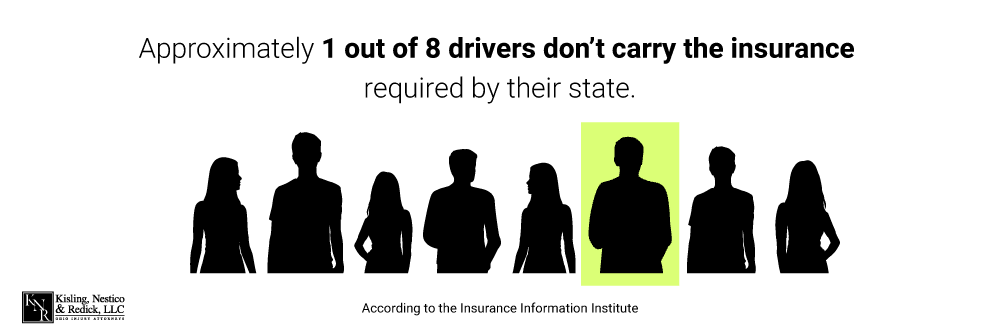
According to the Insurance Information Institute, many drivers don’t carry the insurance required by their state, approximately one out of eight drivers.
Uninsured motorist coverage (UM) is optional in Ohio, as is underinsured motorist coverage (UIM). Still, many drivers carry it so they can file a claim with their own insurance if they are hit by an uninsured or underinsured driver, which is how uninsured and underinsured motorist accidents are usually paid. This coverage is designed to protect them, not the uninsured at-fault driver, when the person who caused the crash doesn’t have enough insurance to pay for all the damage.
If you were uninsured and at fault for a crash, the other driver’s UM coverage may help them recover money from their own insurer. You can still be personally liable for additional expenses if the damages from the accident exceed their coverage limits. On the other hand, if you were uninsured but not at fault, the at-fault driver’s liability coverage, not their UM policy, would usually apply to your losses.
Even if you do not have insurance, you should not be held financially responsible for an accident that someone else caused. A car accident attorney can help you understand your rights, evaluate your options, and pursue compensation from the at-fault driver and any available insurance policies.
Your car accident attorney will handle all the legal details of your case, prove the other driver’s negligence, negotiate on your behalf, and push to recover the compensation you deserve for your losses. They can also help you address any penalties related to driving without insurance and ensure you take the right steps to restore your driving privileges.
It’s important that you get the name and information of the other driver involved in the crash, as well as the police report (here is how to get your Ohio crash report). If you fail to obtain insurance information or a police report, you may impair your ability to recover damages from the other driver, whether you have insurance or not. Your attorney can help you gather necessary evidence and present you with other options if you failed to obtain this information at the accident scene.
Yes. In Ohio, fault, not your insurance status, determines who is responsible for paying accident-related damages. If another driver caused the crash, you may pursue a claim against their liability insurance or file a lawsuit. However, you may still face penalties from the state for driving without insurance, which are separate from your injury claim.
No. Ohio law does not automatically bar uninsured drivers from filing personal injury lawsuits. You still have the right to seek compensation from an at-fault driver. That said, your uninsured status may trigger license suspension and other administrative penalties, which your attorney can help you understand and address.
If the at-fault driver is also uninsured or underinsured, it can be harder to collect full compensation. Your attorney will look at all possible sources of recovery, including personal assets, other potentially liable parties, and any available insurance. The sooner you get legal help, the better your chances of identifying a workable path to recovery.
Insurance companies may try to use your uninsured status to cast doubt on your responsibility or judgment. An attorney can argue that, while driving without insurance was a legal mistake, it did not cause the crash. Their focus will be on proving the other driver’s negligence and documenting your legitimate injuries and losses.
It is especially important to talk to a lawyer if you were uninsured at the time of the crash. You may be dealing with injury claims, insurance negotiations, and BMV issues all at once. An attorney can protect your rights, help you avoid costly errors, and pursue the best possible outcome under Ohio’s uninsured driving and injury laws.
Not on that basis alone. The at-fault driver’s liability coverage pays for the harm their policyholder caused, and Ohio has no law that lets the insurer refuse a claim because the injured person did not have a policy of their own. An adjuster may still bring it up to rattle you or to suggest you share the blame, and the insurer can deny or reduce a claim for the usual reasons, such as a dispute over fault or the extent of your injuries. If a denial cites your insurance status, get a lawyer involved.
Being uninsured makes the weeks after a crash harder, but it does not take away your right to be paid by the person who caused it. Call 1-800-HURT-NOW or contact KNR online for a free consultation. There is no fee unless we recover compensation for you.